
Handing a four-year-old a real kitchen knife sounds like the setup to a parenting disaster, not a philosophy. Yet that is exactly what MacKenzie Scott and her then-husband Jeff Bezos did with their own children, and by the time those kids were seven or eight, power tools had entered the rotation too. When Bezos later explained the reasoning behind it publicly, he traced the whole approach back to a single blunt line from Scott. “I would much rather have a kid with nine fingers than a resourceless kid,” she told him, a sentence he still describes as one of the best parenting philosophies he has ever heard. It is a strange thing to admire out loud, and that is exactly what makes it worth taking seriously.
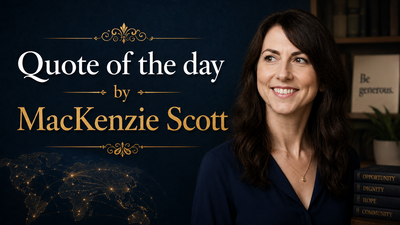
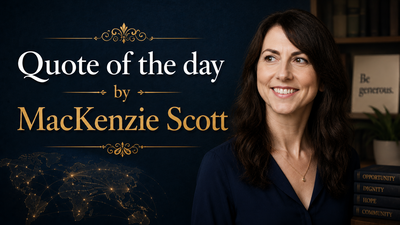
Quote of the day by MacKenzie Scott
“I would much rather have a kid with nine fingers than a resourceless kid”
The parenting story behind the quote
Bezos shared this story publicly at the Summit LA17 conference in 2017, describing how he and Scott raised their four children with far more physical independence than most parents would risk. Knives at four. Power tools by seven or eight. He recalled Scott’s reasoning in her own words, and was quick to add, with visible relief, that all of their children still had a full set of ten fingers.The story works as a parable precisely because of how deliberately extreme it sounds. Scott was not being careless. She was making a considered trade, choosing a small, containable physical risk over what she saw as a much larger, harder to reverse risk: raising children who never learned to handle real tools, real consequences, or real responsibility for their own safety.Bezos framed the whole approach as a form of trust rather than negligence. Handing a child something sharp comes with an implicit instruction: you are capable of handling this carefully, and I expect you to. Removing every sharp object sends a different message entirely, whether or not it is the one a parent intends. It suggests the child cannot be trusted with anything that carries real consequences, an assumption that tends to become true simply because it is never tested.
What is the meaning of the MacKenzie Scott’s quote
Stripped of the specific example, the quote is about which risks are actually worth avoiding. Losing a finger is vivid, immediate and easy to picture, which makes it feel like the obvious danger to protect against. Raising a resourceless child is quiet, gradual and much harder to notice happening, which makes it easy to ignore until the damage is already done.Scott is arguing that the quiet risk is the more serious one. A child who is shielded from every sharp edge and every possible mistake does not end up safe in any lasting sense. They end up unprepared, arriving at adulthood without ever having practised handling something that could genuinely go wrong. The finger is a stand-in for any small, visible cost. The resourcefulness is the thing actually worth protecting.The comparison also exposes an uncomfortable bias in how people usually weigh risk. A cut finger has a clear cause, a clear moment it happened, and someone who can be held responsible for it. A resourceless adult has none of that. There is no single incident to point to, no obvious moment where the harm occurred, which makes it far easier for a parent, a school, or an institution to overlook entirely.
From hedge fund analyst to billion-dollar philanthropist
Scott’s own biography suggests she has taken calculated risks seriously long before this particular parenting story became public. She worked as a research associate at the hedge fund D.E. Shaw in the early 1990s, where she met Bezos, before leaving finance to pursue writing and eventually publishing two novels, The Testing of Luther Albright and Traps.After her divorce from Bezos in 2019, Scott received a significant stake in Amazon and quickly became one of the most unusual figures in modern philanthropy. Rather than building a large foundation with layers of process, she began giving away billions of dollars in largely unrestricted grants, often to organisations that had never received attention from a donor of her scale, and frequently without the lengthy application processes that usually accompany major philanthropy. That same instinct, trusting people and institutions with resources and getting out of the way, runs through both her giving strategy and her parenting story.By 2023, Scott had given away tens of billions of dollars through this approach, an amount that startled a philanthropic sector accustomed to far slower, far more conditional giving. Recipients regularly reported receiving grants with no restrictions on how the money could be spent and no requirement to report back in detail, a level of trust that mirrors the same logic behind letting a child handle a real knife. Give people the tool, expect them to use it well, and resist the urge to manage every step for them.
Why protecting kids from every risk can backfire
Scott’s instinct lines up with a broader argument that has gained traction well beyond her own household. The social psychologist Jonathan Haidt, in his 2018 book The Coddling of the American Mind, co-written with Greg Lukianoff, argues that children who are shielded from every physical risk, social conflict and manageable failure tend to arrive at adulthood more anxious and less capable of handling adversity, not less.Haidt’s argument is not that risk should be pursued for its own sake. It is that a certain amount of manageable difficulty, scraped knees, hard conversations, tools that require care to use safely, teaches a kind of competence that cannot be taught any other way. Removing every opportunity for a child to fail safely does not eliminate risk from their life. It simply delays their first real exposure to it until the stakes are much higher and the safety net is gone.Playgrounds offer a smaller, well documented version of the same pattern. Researchers studying outdoor play have found that removing supposedly dangerous equipment, from climbing structures to seesaws, did not make children measurably safer overall. It simply shifted where and how they took physical risks, often to less supervised settings entirely outside adult view. Eliminating visible risk rarely eliminates risk itself. It tends to relocate it somewhere less controlled.
How to apply this quote in daily life
You do not need to hand a child a kitchen knife to use this idea. The underlying question works in almost any situation where safety and growth pull in different directions: what is the visible, containable risk here, and what is the quieter, larger risk of avoiding it altogether.A manager who reviews every decision an employee makes protects against small visible mistakes, but often produces a team that cannot function without constant supervision. A parent who solves every conflict on a child’s behalf protects against a difficult playground moment, but often produces an adult who has never practised resolving conflict alone. In both cases, the safer looking choice in the moment can be the riskier one over a longer stretch of time.
Other famous quotes by MacKenzie Scott
- “Life will never stop finding fresh ways to expose our shared vulnerability. That’s a reason for more solidarity, not less.”
- “There’s no wrong way to give away a fortune.”
- “People struggling against inequities deserve center stage in stories about change they are creating.”