
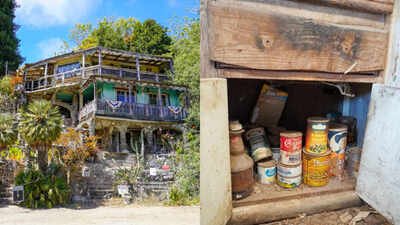
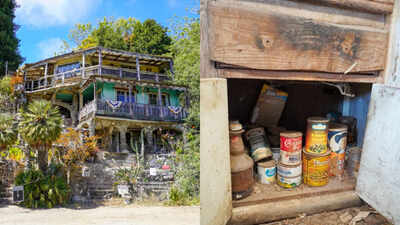
Once, along California’s rugged Central Coast, there was still room for people who wanted to live differently. Away from polished streets and grand estates, the landscape attracted eccentrics, dreamers and determined outsiders who built their own worlds with whatever they could find. One of the strangest and most enduring of those worlds began with a garbage collector, a hillside and a simple one-room shack. According to a Los Angeles Times report, in 1928, Art Beal, an eccentric American folk artist purchased about an acre and a half of pine-covered hillside in Cambria for just $500. Beal, who had worked hauling materials to the nearby construction site of William Randolph Hearst’s magnificent estate, had no interest in replicating Hearst’s grand architecture. For the next five decades, Beal transformed his modest shack into what became known as Nitt Witt Ridge, an extraordinary structure assembled largely from discarded and salvaged materials. His philosophy was simple, never pay for anything except cement. As a garbage collector, Beal had access to an almost limitless supply of things other people had thrown away. He saw possibilities where others saw rubbish. Nitt Witt Ridge eventually grew up the steep hillside in a chaotic maze of eight or nine levels, with rooms, terraces and passageways seemingly emerging wherever Beal found space.
What makes the building special
Its walls and surfaces incorporated car bumpers, rusted wheels, driftwood, shells and countless beer cans. Plaster archways were decorated with abalone shells, dolls and other curiosities. The result was less conventional house than three-dimensional collage, an ever-changing accumulation of objects transformed into architecture. In contrast to Hearst Castle, where wealth produced grandeur through expensive materials, Beal created his own kind of magnificence from things destined for the dump.
From neighborhood eyesore to folk art
By the 1970s, Cambria was becoming an increasingly polished vacation community. New, carefully designed houses were appearing around Beal’s increasingly eccentric creation. Some neighbors considered Nitt Witt Ridge an eyesore and wanted it demolished. But others began seeing something remarkable in the ramshackle structure. Artists, historians and folk-art enthusiasts recognized the house as an example of a uniquely American tradition: the self-taught artist environment, in which a person transforms an ordinary property into a deeply personal work of art. Folk-art advocate Seymour Rosen helped bring attention to Nitt Witt Ridge and played an important role in its preservation, eventually helping secure California State Historical Landmark status for the property.
An unfinished work
Beal never considered the house finished. In 1973, at age 77, he told a Times reporter that he would “never” be done with it. For him, time was secondary to the act of creating. Beal died in 1992 at the age of 96, but his strange hillside masterpiece survived him. A local plumber and his wife purchased the property in 1999 and began offering tours, promoting it as the “Anti-Hearst Castle.” Yet the question surrounding Nitt Witt Ridge has never disappeared: is it an eyesore or a masterpiece?Perhaps it is both. Like much folk art, its power lies precisely in refusing to fit neatly into either category. Nitt Witt Ridge remains a monument to imagination, stubbornness and the peculiar beauty that can emerge when someone looks at discarded objects and sees the foundations of a home.Images Courtesy: RoadTrippers