

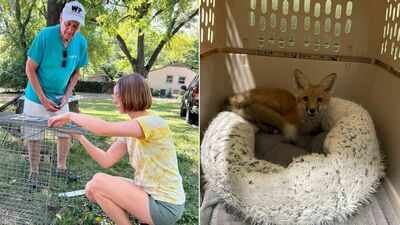
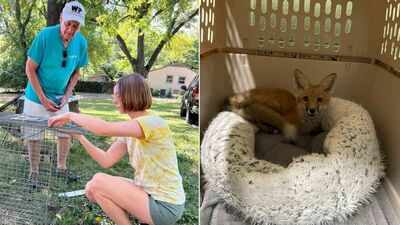
For one Nashville songwriter, answering a call for help can mean getting out of bed in the middle of the night and heading into the woods. At 78, Jerry Vandiver has spent the past seven years volunteering to rescue red foxes suffering from mange around Nashville, Tennessee. In a report, The Tennessean detailed how the singer-songwriter traps sick foxes, transports them to Walden’s Puddle Wildlife Center of Greater Nashville and later helps return them to the wild. Vandiver logged 234 volunteer hours in August alone, while Walden’s Puddle had already rehabilitated more than 60 red foxes by early September, surpassing the 44 it treated throughout all of 2025.
A growing rescue effort for Nashville’s foxes
Vandiver’s work begins when residents spot foxes showing signs of mange. People send him photographs or contact him through Facebook, often asking for help when they see an animal with large patches of missing fur, sores or other signs of the disease. Mange is caused by microscopic skin mites. In foxes, the condition can lead to intense irritation, hair loss, scabbing and open wounds. Without treatment, weakened animals can develop secondary infections and eventually die. The disease is also contagious, making affected foxes a concern for local wildlife populations.For Vandiver, however, the presence of mange does not mean an animal is beyond saving. He has developed a routine for locating and trapping the foxes before transporting them to Walden’s Puddle for professional care. “I’m not the hero, I’m just the ambulance driver,” Vandiver told The Tennessean, explaining that mange is treatable if the animals can be caught and taken for care.
He monitors foxes around Nashville
The rescue work can take considerably more than simply setting a trap. Vandiver uses trail cameras to monitor foxes and understand their movements. Once he identifies an animal that appears to have mange, he works out where to place a trap and what bait to use. The process can take days or even weeks, depending on the animal.When a fox finally enters a trap, Vandiver does not necessarily wait until morning to deal with it. He has said that frightened foxes can injure themselves by repeatedly throwing themselves against the wire enclosure. Instead, he covers the trap with a sheet to help calm the animal, then transports it to Walden’s Puddle. There, the fox is transferred into a crate with food, water and bedding while the rescue centre’s medical staff prepares to treat it. According to Walden’s Puddle animal care manager Joanna Johnson, Vandiver has sent messages about newly trapped foxes at 2 a.m., reflecting how frequently the work extends into the night.
234 volunteer hours in one month
The scale of Vandiver’s commitment has grown alongside the number of sick foxes he encounters. In August 2026 alone, he recorded 234 volunteer hours. By early September, he and other volunteers had already captured more than 60 foxes during the year. That compares with 44 red foxes rehabilitated by Walden’s Puddle during the entire 2025 calendar year. The increase has made 2026 a particularly busy year for the rescue organisation and its volunteers.Vandiver has also become increasingly recognisable among Nashville residents. His social-media presence has expanded as he shares photographs and videos documenting foxes before and after treatment. Good News Network reported that his Facebook following grew from about 325 people to around 5,000 as his rescue work attracted wider attention.
From country songwriting to wildlife rescue
Vandiver’s life in Nashville did not begin with wildlife rehabilitation. He is a longtime singer-songwriter whose work has been recorded by country artists including Tim McGraw, Phil Vassar and Barbara Mandrell. He has also maintained a career as a performer, author and educator. His wildlife work developed alongside that career. For about seven years, he has volunteered with Walden’s Puddle, eventually becoming a regular responder for residents who encounter sick foxes.His experience has also given him a detailed understanding of the animals. Foxes generally live in family groups and require sizeable territories. As development reduces available habitat, foxes can increasingly come into contact with one another or move through areas occupied by other groups, circumstances that can facilitate the spread of contagious diseases such as mange. Good News Network, citing the rescue organisation, also noted concerns about rat poison, which can weaken animals and contribute to their vulnerability.
The goal is to put them back where they belong
The trapping itself is only the first stage of the process. After treatment and recovery at Walden’s Puddle, the foxes are eventually returned to the wild. One recent release illustrated the outcome of the effort. A male fox that Vandiver had trapped after a resident reported it had been in extremely poor condition, with much of its fur missing and its skin covered in sores. Nearly three months later, its coat had grown back and its wounds had healed. Vandiver released the recovered fox back into a wooded Nashville area.For Vandiver, those releases provide a reason to continue despite the long hours. He has described watching a recovered fox disappear into the woods after being released, sometimes looking back briefly before continuing on its way. At 78, the Nashville songwriter is therefore spending much of his time away from recording studios and stages, responding to another kind of call. His work does not replace the veterinary treatment provided by Walden’s Puddle, but it helps bridge the crucial gap between an injured animal being spotted and reaching professional care.