
In July 1969, Ken Schreiber was nine years old when Neil Armstrong became the first person to walk on the Moon. The moment stayed with him, and like Armstrong, Schreiber eventually became a military fighter pilot. Fifty-seven years later, his admiration for the astronaut led him to donate $400,000 to help preserve the house where Armstrong spent part of his childhood.As reported by the Associated Press (AP), the donation enabled the Auglaize County Historical Society to acquire Armstrong’s boyhood home in Wapakoneta, Ohio. The purchase was finalised on October 19, 2026. The society plans to restore the house to its appearance during Armstrong’s childhood and hopes to open it for public tours by 2030, the centenary of his birth.Schreiber, a retired pilot who spent 20 years in the US Air Force before retiring from American Airlines, stepped in after learning that the property was for sale and that no one had come forward to preserve it. He also remembered his father’s advice to “make a mark in life,” something he said had stayed with him.
Why Schreiber decided to help
Schreiber grew up in Dayton, Ohio, about 60 miles south of Wapakoneta. He admired Armstrong for his achievements, modesty and character, according to the AP report. When he read in August 2026 that Armstrong’s childhood home had gone on the market, he became concerned about what might happen to the property. The house was being offered for sale for the first time in nearly 40 years, and there had been no immediate effort to secure its future as a historic site.Schreiber initially asked friends to contribute towards buying the house. He eventually decided to donate the $400,000 himself, making it possible for the historical society to acquire the property. Despite growing up relatively close to Armstrong’s hometown, Schreiber had never visited the Armstrong Air and Space Museum until the summer of 2026. He also toured the house.
The house where Armstrong built model planes
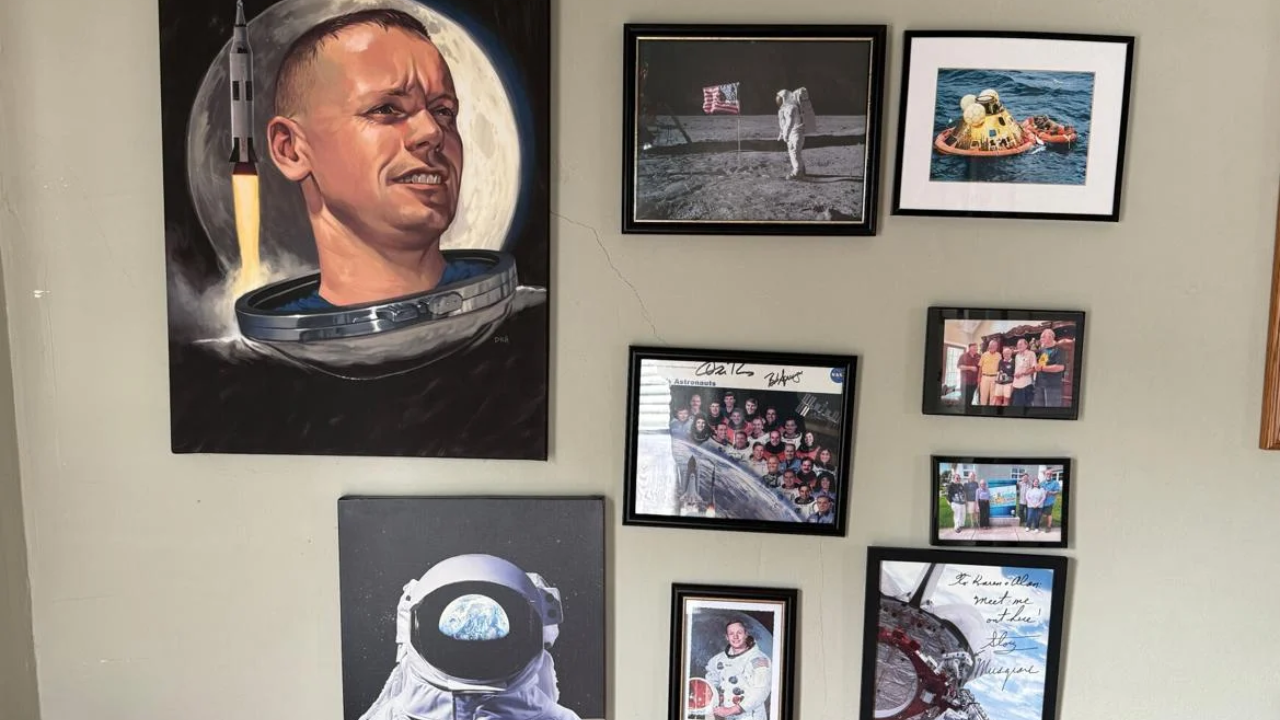
A wall of portraits inside the former bedroom of Neil Armstrong in Wapakoneta, Ohio. (Photo credit: AP Photo/Patrick Aftoora-Orsagos)
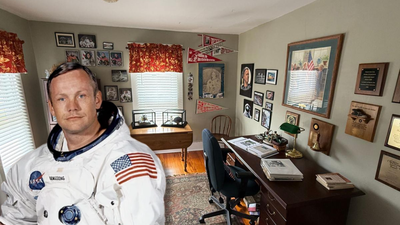
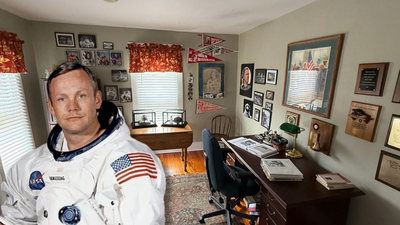
According to AP, The two-storey house at 601 W. Benton Street played an important role in Armstrong’s early interest in aviation. His family bought the property in 1944, when he was a teenager, after moving several times because of his father’s work. As per AP’s earlier report on the property, Armstrong built model aeroplanes using balsa wood and glue in the dining room. He tested them in a wind tunnel he had constructed in the basement.He also launched model planes from the rear window of his bedroom to see how far they would fly. The house was part of the environment in which he developed his interest in flight, years before he became an astronaut. Armstrong made his first solo flight and earned his pilot’s licence at the age of 16. Two decades later, he travelled to the Moon as commander of Apollo 11, alongside Buzz Aldrin and Michael Collins. On July 20, 1969, Armstrong stepped onto the lunar surface.The house remains largely similar in its exterior and internal layout, although it has been updated over the years. Armstrong’s former bedroom now contains photographs and paintings related to the Moon landing, along with signed photographs of astronauts who have visited.
The previous owner wanted to preserve its history
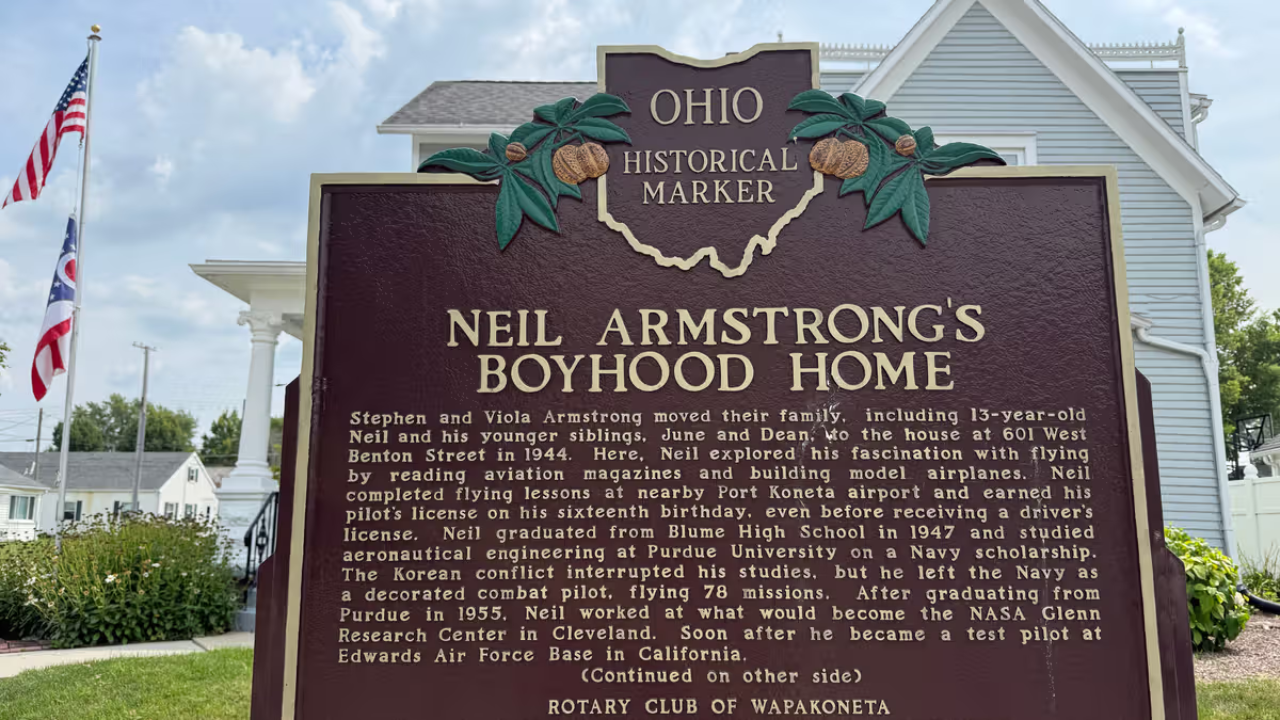
An Ohio historical landmark sign is displayed outside the former home of Neil Armstrong Friday, July 31, 2026, in Wapakoneta, Ohio. (AP Photo/Patrick Aftoora-Orsagos)
Karen Mikesell, a retired history teacher, bought the house in 1988. She worked to preserve its character and welcomed astronauts who wanted to see where Armstrong had grown up. According to the AP, Mikesell hosted nine astronauts over the years, including Buzz Aldrin, who visited Armstrong’s former bedroom several years after Armstrong died in 2012. She believed the house had historical value beyond its connection to a famous astronaut and wanted it to remain a place that could inspire future generations. The house was never formally open to the public, although it became a stop for visitors to the nearby Armstrong Air and Space Museum who wanted to learn more about the astronaut’s early life.
Local leaders welcome the preservation effort
The purchase has also drawn support from the local community. As reported by American media house Hometown Stations, Wapakoneta Mayor Dan Lee described the house as a place where Armstrong’s early dreams took shape. He also referred to Armstrong’s early efforts to learn to fly, noting that he cycled to the airport to earn his pilot’s licence before he could drive a car. Lee thanked Schreiber for supporting the preservation of the property, describing the donation as an investment in American history.
When will the house open to visitors?
The Auglaize County Historical Society plans to restore the property to reflect how it looked in the 1940s, when Armstrong lived there. The work will require further fundraising and research into the house’s original appearance. The Wapakoneta Community Foundation has also established a fund to support the property’s upkeep and restoration, according to Hometown Stations. Schreiber’s donation has secured the property for the historical society, but restoration and maintenance will require additional support. The planned opening will depend on the work being completed and the funds being raised.