

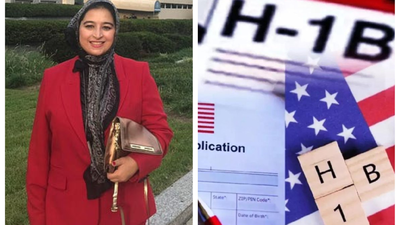
The US Department of Labor recently announced the suspension of Cognizant from filing new Permanent Labor Certification (PERM) applications as a probe into alleged visa fraud is going on. Mahvash Siddiqui, an Indian-origin US diplomat who worked at the Chennai consulate two decades ago, claimed that junior officers repeatedly told their seniors how IT conglomerates game the visa system but they were never paid any attention.Siddiqui reacted to the PERM cancelation of Cognizant as she wrote an article for Center for Immigration Studies detailing her experience and understanding from the work she had done at the visa frontline 20 years ago. She said even 20 years ago, the workload was immense as they were adjudicating hundreds of visa applications daily. Siddiqui recalled that there was a Business Express program at that time which offered a fast visa adjudication for IT outsourcing firms like TCS, Wipro, Satyam, Infosys, Accenture and Cognizant. But not only foreign IT firms, Us firms like General Electric, Microsoft, and Honeywell, too were also accorded fast services where their employees were granted “top-brass” handling with minimal documentary scrutiny.
Corporate facade collapsed at visa interview desk
Siddiqui said she had an academic and technical background and two of her sisters were computer engineers. She had sufficient knowledge of computer science and software architecture to question candidates going beyond the expected questions.“When basic computer science and engineering concepts were tested during expedited interviews, the corporate facade collapsed quickly across both foreign and domestic multinational applicants,” she said, identifying three issues that she encountered during those interviews.Fake degree: Siddiqui said many applicants had no formal degree in computer science but they just completed some brief training modules like short Microsoft Certified Systems Engineer courses or elementary graphic design classes.B1/B2 abuse: Tourist or business visa applicants cited reasons like “gaining knowledge”, “project coordination” but they all were placed on-site and then transitioned to H-1B.Third-party corruption: “Third-party recruiters and corrupt corporate HR handlers systematically monetized access to the Business Express Program, charging underqualified individuals illicit fees to slip them into the corporate applicant pool,” Siddiqui said.“A consular adjudicator sitting at the visa window conducts tens of thousands of interviews per year. Through daily, direct interaction, an officer’s judgment becomes exceptionally refined. Adjudicators learn to detect fraud patterns, recognize rehearsed lines, and identify broader structural patterns across thousands of cases. In contrast, Non-Immigrant Visa Chiefs and senior diplomatic managers sit at administrative desks, distant from daily interviews, focusing on macro-level throughput, operational metrics, and diplomatic ties with corporate executives,” she said.
Administrative pressure to issue visas
Siddiqui said the Chennai Consulate General at that time favoured principled adjudication but there was pressure from the highest level of the mission to increase the volume. ” The consular chief in Delhi who oversaw all India missions, heavily focused on processing volume and managing bilateral commercial relations, routinely enforced a managerial culture of “issue, issue, issue,” she added.“When junior officers submitted formal fraud referrals regarding Cognizant, Satyam, TCS, and multinational corporate partners, senior managers repeatedly dismissed these concerns. Executive leadership routinely praised Cognizant and other corporate actors as “top-notch” entities without ever examining individual credentials with the rigor required at the window. As a result, corrupt HR managers and corporate entities operated a virtually unimpeded pipeline into the US labor market,” Siddiqui said“Had leadership backed the officers on the line, taken our fraud referrals seriously, and dismantled corporate fast-track loopholes two decades ago, decades of systemic visa abuse, wage suppression, and immigration fraud could have been prevented. A stitch in time would have saved nine,” she added.