

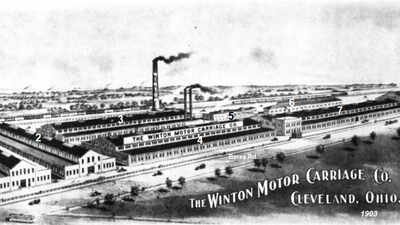
There was a time when Cleveland’s Berea Road was home to one of America’s most important automobile factories. Now, after decades of changing uses and a near-demolition, the sprawling former Winton Motor Carriage Works is getting another chance. According to NEOtrans, aGreater Cleveland developer has acquired the long-vacant industrial complex for $300,000 and is preparing a phased redevelopment of the historic property. Scroll down to read the details.
From demolition target to redevelopment
According to NEOtrans report, the four-parcel property in Cleveland’s Cudell neighborhood covers 7.3 acres and contains about 260,000 square feet of brick factory buildings. Developer John Ellis, through Winton Works Ltd., led the acquisition from Legacy Property Investments VI Ltd., an affiliate of Weston Inc. The purchase comes only months after the property appeared headed for demolition. In February, Weston had sought permission to tear down about 183,000 square feet of the remaining factory complex, with the intention of making the site more attractive to a new industrial user.The structures are assessed by Cuyahoga County as being in fair to very poor condition, and the new ownership has begun work to secure and maintain the site. Redevelopment plans are being developed in stages and are expected to cover the entire property.
A major project for the new owner
For Ellis, whose portfolio includes Northeast Ohio development and construction projects, Winton Works represents his largest undertaking to date. Potential tenants have already been identified, although they have not been publicly disclosed. The acquisition also involves TCWB OR LLC, an affiliate of Equity Advantage, which holds a 95% interest alongside Winton Works Ltd.’s 5%. The arrangement is being used for a reverse 1031 exchange, a real estate mechanism that allows an investor to acquire replacement property before selling another asset while potentially deferring capital gains taxes. The immediate priority is bringing the old industrial complex back to a stable, maintained condition before more substantial redevelopment begins.
The factory that helped shape the automobile
According to NEOtrans, the property’s significance goes well beyond its size. Winton Motor Carriage Co. was founded in 1897 by Alexander Winton, a Scottish-born bicycle maker who turned his attention to automobiles. Winton produced Cleveland’s first commercially manufactured automobile in 1898. The company expanded rapidly, and by the beginning of the 20th century its roughly 500,000-square-foot factory was the largest automobile plant in the United States. Winton was also the country’s largest manufacturer of gasoline-powered cars at the time.One of its vehicles completed the first transcontinental automobile journey in 1903, helping establish the company’s reputation during the early years of the American automobile industry. Winton later shifted toward luxury vehicles and diesel engines as mass-produced cars from Henry Ford’s factories changed the economics of the industry. General Motors acquired Winton in 1930, eventually operating the facility as part of its Cleveland Diesel Engine Division before relocating operations elsewhere in 1962.
A second life for an industrial landmark
The factory did not disappear after the automotive era. Over the decades, the property housed a succession of businesses and entertainment venues, including Gair Cleveland Cartons, Superior Wrought Washer, Cleveland Railway, Roman Chariot auto parts and several nightlife establishments. Its latest chapter could be more closely tied to its history. With redevelopment plans taking shape, the goal is no longer simply to clear the land and start over. Preserving the existing buildings offers an opportunity to bring new activity to a piece of Cleveland’s industrial past while retaining the physical character of the original complex.For a property that came close to being reduced to an empty development site, the shift is significant: Winton Works is moving from demolition plans toward a new life built around reuse.Image Courtesy: NEOtrans